
Learning to fly means understanding the invisible forces that keep aircraft airborne. The principles of flight explain how four fundamental forces work together to achieve controlled flight. Lift opposes weight, thrust overcomes drag, and when pilots master these relationships, they can safely navigate through the sky.
Key Takeaways
- Four forces govern all flight: Lift, weight, thrust, and drag must be balanced for straight and level flight
- Lift depends on multiple factors: Airspeed, angle of attack, wing area, air density, and the lift coefficient all influence how much lift a wing generates
- Understanding these principles is essential: Whether you're pursuing a private pilot license or advancing your aviation knowledge, mastering aerodynamics forms the foundation of safe flying
Ready to start your pilot career training? Contact Hillsboro Aero Academy today to learn how our instructors can guide you through the principles of flight.
Start Your Aviation Journey With Confidence
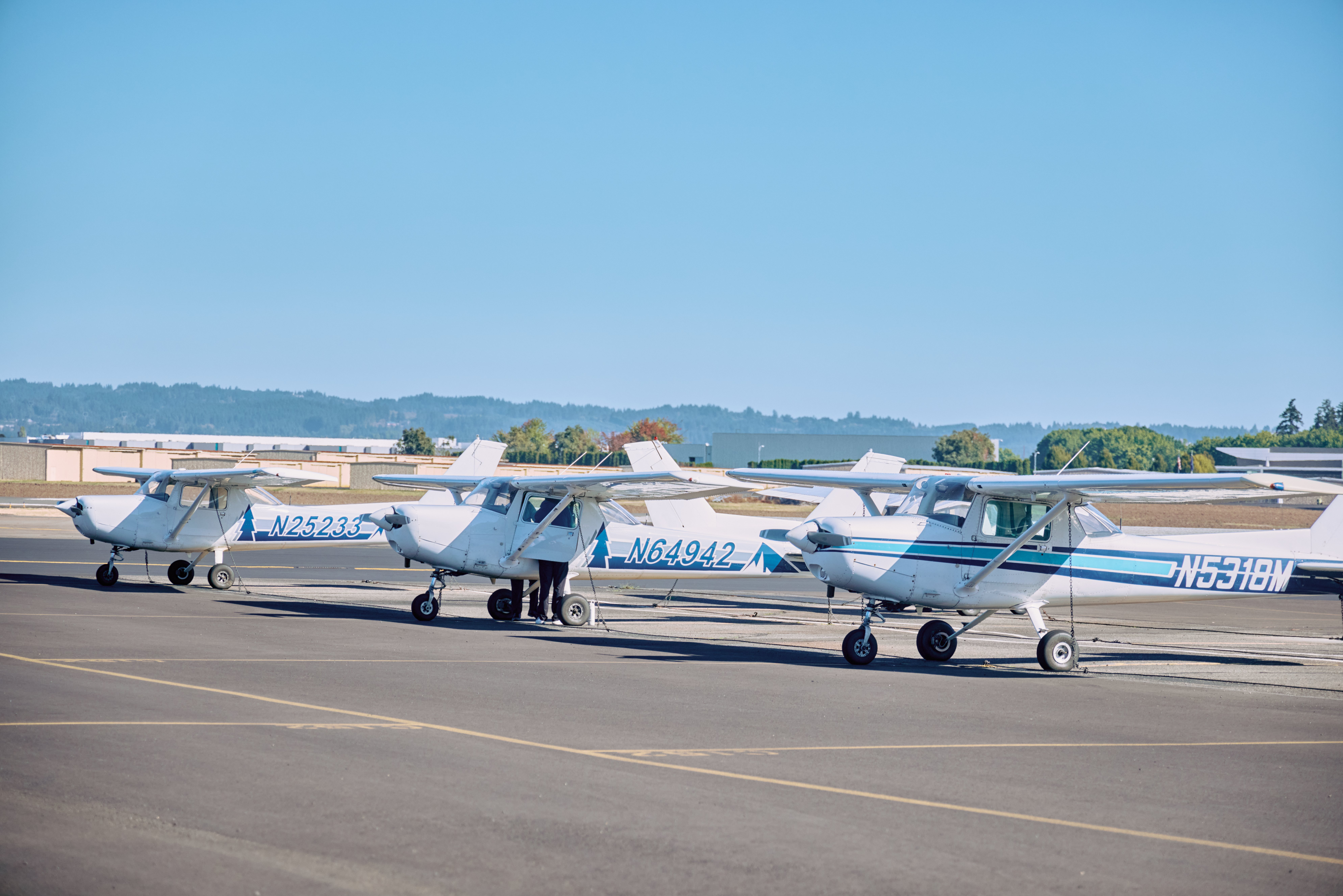
Understanding the principles of flight transforms abstract concepts into practical knowledge you'll use every time you fly. At Hillsboro Aero Academy, our instructors guide students through these fundamental concepts with hands-on training in diverse Oregon flight conditions.
Whether you're interested in becoming an airplane pilot or exploring various pilot license types, mastering aerodynamics gives you the foundation for successful aviation career training.
Ready to experience these principles firsthand? Contact us today to learn more about our FAA-approved training programs and discover how we can help you achieve your aviation goals.
The Four Forces of Flight: Understanding the Foundation
Every aircraft in sustained flight experiences four fundamental forces. Lift acts perpendicular to the relative wind and points upward, generated primarily by the wings as air flowing over and under them creates pressure differences. Weight acts downward toward Earth's center due to gravity, representing the combined mass of the aircraft, fuel, passengers, and cargo. Thrust is the forward force produced by the airplane engine (or engines) that propels the aircraft through the air. Drag acts rearward as an opposing force, resisting the airplane's forward motion through the air.
For an aircraft to maintain level flight at constant speed, these opposing forces must balance perfectly. The lift force must equal the aircraft's weight, and the thrust vector must equal the drag vector. When this equilibrium exists, the aircraft flies straight without climbing, descending, or accelerating. Below is a table that describes how these forces and pilot inputs interact.
|
Force |
Direction |
What Generates It |
How Pilots Control It |
|
Lift |
Upward (perpendicular to relative airflow) |
Wings moving through air, pressure difference |
Angle of attack, airspeed, flaps |
|
Weight |
Downward (toward Earth) |
Gravity acting on aircraft mass |
Fuel consumption, payload management |
|
Thrust |
Forward (direction engine points) |
Engine/propeller accelerating air |
Throttle/power settings |
|
Drag |
Rearward (opposing force to motion) |
Air resistance, friction |
Airspeed, aircraft configuration |
The FAA's Pilot's Handbook of Aeronautical Knowledge provides detailed explanations of how these forces of flight interact during different phases of flight. Understanding these relationships is critical before students even step into the cockpit.
How Wings Generate Lift: The Physics Behind Flight
Lift is the upward force created when air flows over and under a wing, generating a pressure difference that pushes the wing upward. Two complementary explanations describe how a wing generates lift.
Bernoulli's Principle states that as air speeds up over a surface, its pressure drops. Wings are shaped so the upper surface is more curved than the lower surface. Air flowing over the top must travel a longer path, increasing its speed and creating lower air pressure above the wing. Meanwhile, air moving underneath maintains higher pressure. This pressure difference between the upper and lower surfaces creates the lift force.
Newton's Third Law provides the other half of the explanation. As the wing deflects air downward (changing its momentum), the air pushes the wing upward with equal and opposite force. Both principles work simultaneously. The pressure distribution described by Bernoulli and the momentum change described by Newton represent two ways of analyzing the same physical phenomenon.
The Lift Equation: Calculating How Much Lift
The lift equation quantifies exactly how much lift a wing produces:
L = Cl × A × 0.5 × ρ × V²
Where:
- L = Lift force
- Cl = Lift coefficient (depends on wing shape and angle of attack)
- A = Wing area
- ρ = Air density
- V = Airspeed
This equation reveals several critical relationships. Lift increases with the square of velocity, meaning doubling your airspeed produces four times the lift. Lift is directly proportional to wing area, which is why larger aircraft need bigger wings. As air density decreases with altitude, aircraft must fly faster or at higher angles of attack to maintain the same lift generated at lower altitudes.
The AOPA explains the lift equation in practical terms that help student pilots understand how changing one variable affects overall performance.
Angle of Attack: The Pilot's Primary Lift Control
Angle of attack is the angle between the wing's chord line and the relative wind direction. This is the most important factor pilots directly control to influence lift during flight.
As angle of attack increases from zero degrees, the lift coefficient increases proportionally. Pilots can maintain altitude at slower airspeeds by increasing the angle of attack to produce more lift. However, this relationship has a critical limit called the critical angle of attack, typically between 15 and 20 degrees, depending on airfoil design.
Pro Tip: Stall occurs at the same angle of attack regardless of airspeed. An aircraft can stall at any speed if the critical angle of attack is exceeded.
When the angle of attack exceeds this critical value, airflow separates from the upper wing surface. The smooth flow of air breaks down, lift coefficient drops dramatically, and the wing stalls. Understanding this principle is essential for flight safety, especially during turns where increased load requires higher angles of attack.
Understanding Drag: The Force That Opposes Motion
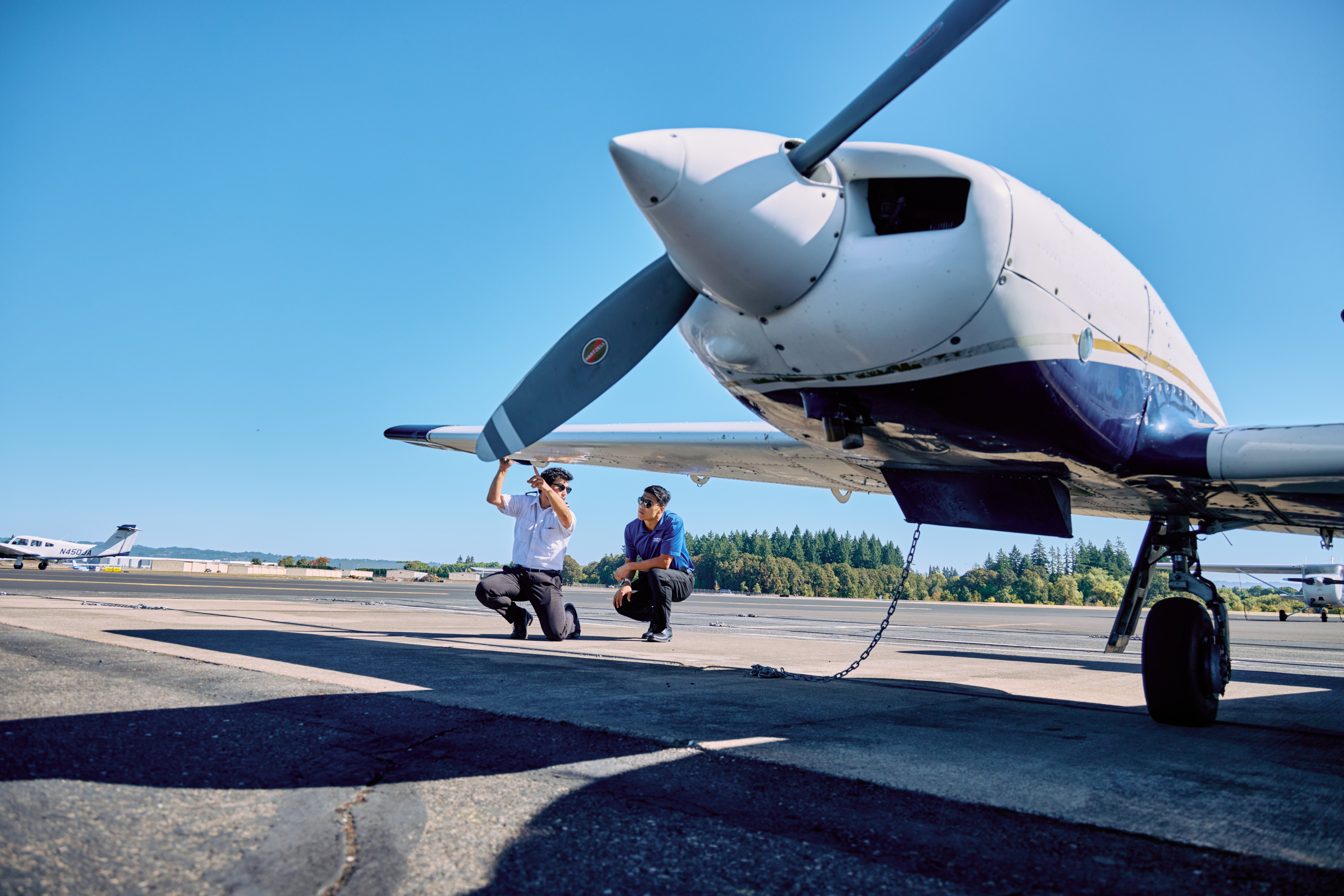
Drag is the aerodynamic resistance that acts rearward, opposing the airplane forward through the air. The drag vector acts parallel to the relative wind but in the opposite direction of flight. Aircraft designers work to minimize drag while pilots manage it through speed and configuration changes.
Drag comprises two distinct components with different characteristics:
|
Drag Type |
What Causes It |
How It Changes With Speed |
How to Reduce It |
|
Parasitic Drag (includes form drag) |
Air pressure around aircraft shape, skin friction |
Increases with the square of airspeed |
Streamlined design, smooth surfaces |
|
Induced Drag |
Byproduct of lift generation, wingtip vortices |
Decreases as airspeed increases |
High aspect ratio wings, winglets |
Parasitic Drag: Friction and Form
Parasitic drag includes form drag (pressure drag from the aircraft's shape) and skin friction drag (caused by air molecules moving across the aircraft surface). Less streamlined shapes create more form drag. Smoother surfaces produce less friction drag.
Air acts as a viscous fluid, creating a thin boundary layer near the aircraft surface where air velocity transitions from zero at the surface to free stream velocity. Within this boundary layer, two flow regimes exist. Laminar flow moves in smooth parallel layers and produces significantly less drag than turbulent flow, where air exhibits chaotic three-dimensional motion.
Aircraft designers pursue laminar flow over as much wing area as possible. A wing maintaining laminar flow over its upper surface can produce nearly half the drag of an equivalent wing with fully turbulent flow. Surface contamination as minor as dirt or ice disrupts laminar flow and significantly increases drag.
Induced Drag: The Cost of Producing Lift
Induced drag is the rearward component of force created as a direct consequence of generating lift. When wings produce lift, they must deflect air downward. At wing tips, high-pressure air from below curls around the tip into the low-pressure region above, creating counter-rotating vortices that trail behind the aircraft.
These wingtip vortices induce downward airflow over the wing, reducing the effective angle of attack. To compensate and maintain the same lift, the wing must increase its physical angle of attack. This increased angle creates an additional rearward force component called induced drag.
According to SKYbrary's aerodynamics resources, induced drag increases with the square of the lift coefficient and decreases with wing aspect ratio (wingspan divided by average chord). Long, slender wings produce less induced drag than short, stubby wings generating the same total lift.
Winglets directly address induced drag by disrupting wingtip vortex formation. The winglets market reached 2.8 billion USD in 2024 and is projected to grow at 8.2% annually through 2034, reflecting the aviation industry's commitment to drag reduction. Modern winglet designs deliver measurable fuel savings, typically 4 to 6% on long-haul flights.
Finding the Sweet Spot: Minimum Drag Speed
The relationship between parasitic and induced drag creates an important principle. There exists an optimal airspeed where total drag reaches its minimum value. At slower air speeds, induced drag dominates because the aircraft must fly at higher angles of attack to maintain altitude. At faster speeds, parasitic drag dominates because it increases with the square of velocity.
This minimum drag speed represents the theoretical maximum range speed. In practice, aircraft typically cruise slightly above this speed to maintain acceptable safety margins and flight stability.
Thrust: The Force That Moves Aircraft Forward
Thrust is the propulsive force generated by aircraft engines that enables the airplane to move forward and overcome drag. The thrust vector generally acts in the direction the engine is pointing, creating forward motion.
Thrust generation follows Newton's third law. As engines accelerate air or exhaust gases in one direction (rearward), the aircraft experiences a reaction force in the opposite direction (forward). The magnitude of thrust depends on the mass flow rate of air passing through the engine and the velocity change imparted to that flow.
Different propulsion systems generate thrust through distinct methods:
Propeller-driven aircraft accelerate a large mass of air at relatively low velocity. The propeller functions aerodynamically like rotating wings, creating thrust through pressure distribution changes around the spinning blades. Different sections of the propeller blade move at different velocities, with blade tips moving faster than the hub.
Jet engines accelerate a smaller mass of air to much higher velocities through compressors and combustion chambers. Thrust results from the reaction force associated with accelerating exhaust gases rearward, not from gases "pushing" against the aircraft.
Modern propulsion continues evolving toward greater efficiency. Airbus's EcoPulse program completed comprehensive flight testing in 2024 after first flying in November 2023. The system integrates six electric propellers distributed along the wings, powered by a turbogenerator and high-voltage battery pack delivering up to 350 kilowatts. The 100 hours of testing across approximately 50 flights demonstrated how distributed hybrid-electric propulsion can reduce fuel consumption while maintaining performance.
How Thrust and Drag Determine Performance
In straight and level flight at constant speed, thrust equals drag. When pilots increase thrust beyond the drag requirement, the aircraft accelerates. During acceleration, both airspeed and altitude may increase until reaching a new equilibrium where thrust again equals drag at a higher energy state.
When thrust is reduced below drag, the aircraft descends until either reaching an altitude where denser air increases available thrust, or the pilot increases engine power. These force relationships determine maximum altitude, rate of climb, cruise efficiency, and other critical performance characteristics.
Weight and Balance: Critical Factors in Aircraft Control
Weight acts downward toward Earth's center through gravitational attraction. The aircraft's weight includes the airframe, engines, systems, fuel, passengers, and cargo. The weight vector acts through a point called the center of gravity, which represents where an aircraft would balance if suspended.
Aircraft weight constantly changes during flight as engines consume fuel. This shifting weight distribution requires continuous adjustment of control inputs or automated trim systems to maintain desired flight attitudes. The center of gravity must fall within specific manufacturer-established limits for safe operation.
A forward center of gravity increases longitudinal stability but reduces elevator control authority, making it harder to raise the nose. An aft center of gravity reduces stability and can render the aircraft dangerously unstable, though it provides enhanced control authority.
The relationship between weight and lift requirements follows directly from the lift equation. As aircraft weight increases (through fuel loading, passenger and cargo loading, or ice accumulation), the required lift to maintain altitude at any given airspeed increases proportionally. Heavier aircraft require higher airspeeds or must fly at higher angles of attack, both of which increase induced drag.
Understanding weight and balance is part of comprehensive flight training that prepares students for real-world flying scenarios.
Flight Dynamics: Climb, Descent, and Turning Flight
Achieving Climb
To climb from level flight, two conditions must be satisfied: lift must exceed weight, and thrust must exceed drag. Pilots achieve this by increasing thrust (advancing the throttle) and raising the nose (increasing angle of attack).
Increasing the angle of attack increases the lift coefficient, causing wings to generate more lift. Simultaneously, increased thrust overcomes drag more effectively. The resultant of thrust and lift vectors must exceed the combined resultant of drag and weight vectors for the aircraft to climb.
In a constant-airspeed climb, the pilot adjusts pitch and power so the aircraft reaches a new equilibrium at a higher altitude where thrust again equals drag and lift equals the component of weight perpendicular to the flight path.
Controlled Descent
In descent, weight exceeds lift, and the gravitational force component along the flight path exceeds available thrust. Depending on descent profile, the pilot may reduce thrust to near-idle and rely primarily on gravity, or may descend at shallower angles while maintaining higher power settings.
Equilibrium descent requires specific thrust settings so the aircraft maintains a steady descent rate with all forces and moments balanced.
The Physics of Turns
Turning flight introduces load factor, which increases stall speed and affects all performance characteristics. During a level turn (maintaining altitude), the vertical component of lift must equal weight while the horizontal component provides centripetal force to curve the flight path.
As bank angle increases, pilots must increase angle of attack to generate additional total lift. This requirement creates load factor, defined as the ratio of total lift to weight:
- 45-degree bank: Load factor = 1.41 (41% increase in effective weight)
- 60-degree bank: Load factor = 2.0 (100% increase in effective weight)
Pro Tip: Stall speed increases proportionally to the square root of load factor. An aircraft stalling at 50 knots in level flight will stall at approximately 71 knots in a 60-degree bank turn.
This relationship creates hazardous situations when pilots attempt steep turns at low speeds. The margin between safe maneuvering speed and stall speed shrinks as bank angle increases. Pilots receive training to maintain turn performance within safe limits by adhering to maneuvering speed restrictions.
Advanced Aerodynamic Concepts
Ground Effect: Flying Close to the Surface
Ground effect occurs when aircraft fly within approximately one wingspan of the ground or water surface. The surface beneath disrupts wingtip vortex formation by blocking the downwash of air behind the wing. This reduces induced drag and creates an apparent increase in lift for any given angle of attack.
Pilots notice ground effect during takeoff when the aircraft "floats" over the runway as it approaches rotation speed. During landing, ground effect causes the aircraft to float further down the runway than desired, requiring more aggressive power reduction to achieve a timely touchdown.
Ground effect is more pronounced for low-wing aircraft and strongest over smooth, firm surfaces like concrete runways compared to rough grass fields.
Dynamic Pressure and Airspeed Effects
Dynamic pressure is the kinetic energy per unit volume of air flowing past the aircraft. It appears in both the lift equation and drag calculations, increasing with the square of velocity. This relationship explains why small airspeed changes produce large changes in both lift and drag.
At higher air speeds, dynamic pressure increases dramatically. This allows wings to generate the required lift at lower angles of attack but also increases parasitic drag substantially. Pilots constantly balance these competing effects to achieve efficient flight.
The Role of Air Density and Altitude
Air density decreases with altitude, directly affecting how much lift and thrust an aircraft can generate. At higher altitudes, thinner air means:
- Wings must fly faster to generate the same lift
- Engines produce less thrust
- True airspeed is higher than indicated airspeed for the same dynamic pressure
This is why aircraft have maximum operating altitudes. Above certain altitudes, engines cannot produce enough thrust to overcome drag, even at maximum power settings.
Understanding how different training programs approach these concepts helps students choose the right path for their aviation education.
Modern Innovations in Aerodynamics
Winglets and Vortex Control
Modern aircraft increasingly incorporate winglets and other wingtip devices to reduce induced drag. These devices disrupt wingtip vortex formation, weakening the counter-rotating airflow that creates drag.
Blended winglets, accounting for approximately 28% of market revenue share, employ upward-swept designs that reduce drag while maintaining structural efficiency. Advanced materials, including composites and high-strength alloys, enable these designs to withstand aerodynamic loads while remaining lightweight.
Computational Advances
Three-dimensional computational fluid dynamics (CFD) enables engineers to optimize complex shapes and predict aerodynamic performance with unprecedented accuracy. This reduces the need for extensive physical wind tunnel testing while enabling faster iteration of design concepts.
Digital twin technology creates virtual replicas of aircraft that update in real time with sensor data from actual flights. These systems enable continuous monitoring of aerodynamic performance and prediction of maintenance needs, identifying performance degradation from surface contamination or structural wear.
Sustainable Aviation Design
Aircraft in development for the 2030s incorporate wings optimized for laminar flow maintenance, advanced winglet designs, and fuselage shaping to reduce pressure-induced separation. Every percentage point improvement in aerodynamic efficiency translates to proportional reductions in fuel consumption and emissions.
The recognition that aerodynamic optimization directly reduces environmental impact has motivated unprecedented investment in research and development across the aviation industry.
Practical Applications for Student Pilots
Understanding Angle of Attack Indicators
Angle of attack indicators directly display how close to stall the aircraft is operating, independent of airspeed. Traditional airspeed indicators can mislead pilots into thinking slower speeds always indicate higher stall risk. In reality, stall depends on the angle of attack exceeding critical values.
An aircraft approaching landing at 1.3 times stall speed operates at a specific angle of attack. That same aircraft in a steep bank must increase the angle of attack substantially to maintain altitude, approaching stall at a higher airspeed. Angle of attack indicators remove this ambiguity.
Managing Configuration Changes
Flaps and other high-lift devices modify wing shape to change the lift coefficient for any given angle of attack. Deploying flaps increases wing camber and often increases total wing area, providing substantial lift increases that reduce stall speed.
This allows aircraft to fly safely at slower speeds during takeoff and landing operations. Pilots must understand how configuration changes affect the relationship between all four forces to maintain safe flight at all times.
Weather and Atmospheric Considerations
Wind shear (rapid changes in wind speed or direction over short distances) dramatically affects force balance, particularly during landing and takeoff when aircraft are slow and near terrain. As an aircraft encounters a decreasing headwind during approach, its airspeed decreases, causing a proportional decrease in dynamic pressure and lift.
If wind shear is strong enough or occurs too low for recovery, the aircraft may be forced below glide path. Pilots receive explicit training to recognize and escape wind shear; however, prevention through thorough meteorological briefing remains the most effective approach.
Frequently Asked Questions
Can airplanes fly upside down?
Yes, airplanes can fly upside down, though it requires specific techniques. When inverted, the wing's angle of attack relative to the airflow must be adjusted to generate lift in the upward direction (which points toward the ground when inverted). Aerobatic aircraft are specifically designed with symmetrical airfoils that perform well in inverted flight. The pilot must maintain a sufficient airspeed and a proper angle of attack to continue producing lift. Flying upside down requires significant skill and is typically performed only by trained aerobatic pilots in specially designed aircraft.
What conditions are needed to achieve flight?
To achieve flight, an aircraft must generate lift force equal to or greater than its weight. This requires sufficient airspeed to create adequate dynamic pressure over the wings, a proper angle of attack to maximize lift coefficient, and enough thrust to accelerate to and maintain flying speed. Air density also plays a critical role, as denser air generates more lift at a given airspeed. Before sustained flight can occur, thrust must overcome both drag and any weight component along the flight path. The combination of these factors determines whether an aircraft can successfully become airborne and maintain controlled flight.
How do pilots maintain altitude during flight?
Pilots maintain altitude by ensuring lift equals weight while thrust equals drag. This equilibrium keeps the aircraft in steady, level flight without climbing or descending. Pilots adjust pitch attitude (controlling angle of attack) and power settings (controlling thrust) to achieve this balance. As conditions change (fuel consumption, reducing weight, air density variations with altitude, or airspeed changes), pilots make continuous small adjustments. Modern aircraft include trim systems that help maintain desired attitudes with minimal control pressure. Autopilot systems can automatically maintain altitude by continuously adjusting pitch and power based on sensor inputs.
What are the key flight characteristics pilots monitor?
Key flight characteristics pilots monitor include airspeed (ensuring adequate margin above stall speed), altitude (maintaining assigned flight levels), heading (tracking intended course), angle of attack (especially during slow flight and landing), engine parameters (RPM, manifold pressure, temperatures), and aircraft attitude (pitch and bank angles). Pilots also monitor vertical speed (rate of climb or descent), coordination (preventing slips or skids in turns), and configuration status (flaps, landing gear). Modern glass cockpits integrate these parameters into comprehensive displays, while traditional instruments present them on individual gauges. Understanding how these characteristics interrelate helps pilots maintain safe, efficient flight.
__
This article presents a general overview of the field of aviation, including job opportunities within that field; it does not describe the educational objectives or expected employment outcomes of a particular Hillsboro Aero Academy program. Hillsboro Aero Academy does not guarantee that students will obtain employment or any particular job. Some positions may require licensure or other certifications. We encourage you to research the requirements for the particular career you desire.